

How to Clean Intimate Toys Properly and Safely
Last Updated: November 1, 2026
Quick Summary
To clean intimate toys, rinse with warm water, wash with mild unscented soap or a dedicated toy cleaner, rinse again, and dry completely before storage. Do this before and after every use, and check your toy's waterproof rating before washing. Porous toys can be cleaned but not reliably sanitised, so replace them if a smell persists.
- Cleaning removes residue, sanitising reduces bacteria, and disinfecting kills most germs, three different jobs.
- Waterproof toys can be rinsed under the tap, but splash-proof and non-waterproof toys should be wiped with a damp cloth only.
- Never charge a damp toy, and wipe around charging ports with a dry cloth or cotton tip.
- Use a new condom for each partner and when switching body areas during shared use.
- Replace porous toys that stay tacky, smell after cleaning, or have cracks and flaking coatings.
Table of Contents
- Why Cleaning Intimate Toys Matters More Than You Think
- Cleaning, Sanitising and Disinfecting: Know the Difference
- How to Clean Intimate Toys Step by Step
- How to Clean Silicone Sex Toys Without Damaging Them
- How to Clean a Vibrator: Waterproof Ratings and Charging Ports
- Choosing a Sex Toy Cleaner and Ingredients to Avoid
- How to Clean Sex Toys Between Partners
- Porous Materials, Storage and When to Replace a Toy
- Frequently Asked Questions
Why Cleaning Intimate Toys Matters More Than You Think
At Ultimate Satisfaction, we hear from customers who've owned a toy for years without ever reading the care instructions.
Watch out: sharing a toy without cleaning it between users is the fastest route to transferring bacteria.
If you're worried about what your toy is actually made of, our guide to identifying toxic materials in toys walks through the warning signs.
Cleaning, Sanitising and Disinfecting: Know the Difference
The three terms get used interchangeably, and that causes real confusion. A dedicated sex toy cleaner usually does the sanitising job. Boiling water or a medical-grade wipe disinfects. Soap and water cleans.
Most people only need to clean and sanitise. Disinfecting matters more after illness, after anal use, or when a toy is shared.
- Clean: wash away lube, fluids and dust
- Sanitise: reduce bacteria with a toy cleaner or mild soap
- Disinfect: kill most germs, usually with boiling water or a registered disinfectant
Material matters here. Silicone and glass tolerate heat. Motors and ABS plastic do not. Check the manufacturer's instructions before you boil anything.
How to Clean Intimate Toys Step by Step
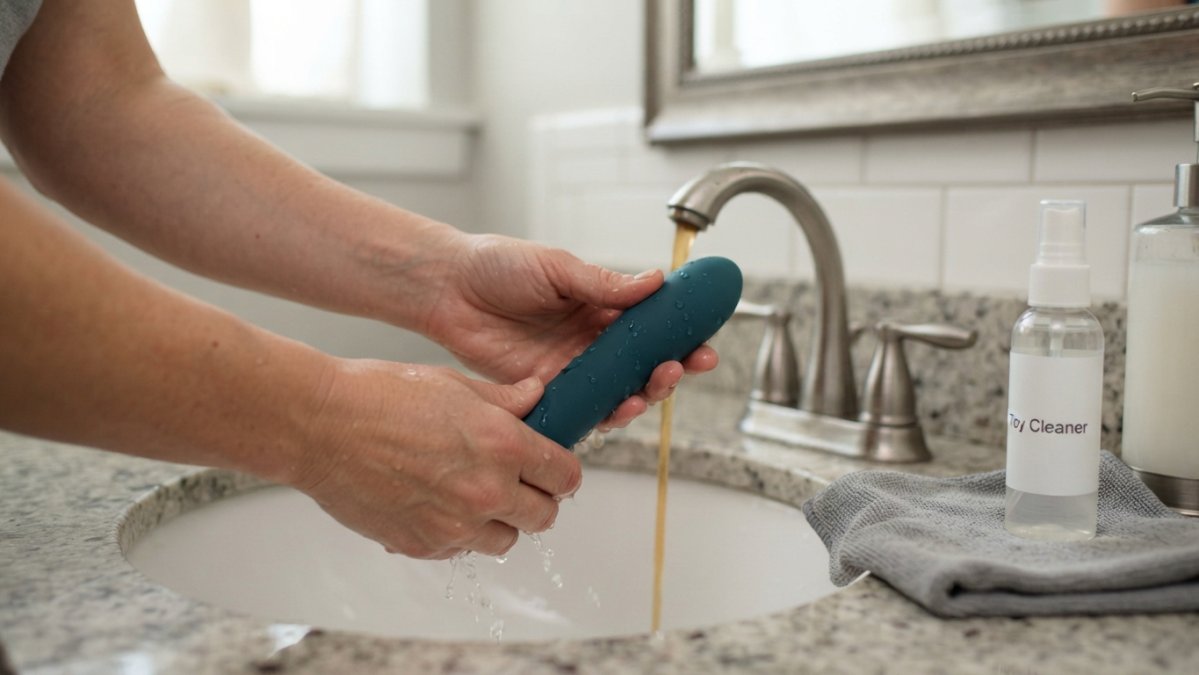
Cleaning intimate toys takes a few minutes and follows the same sequence every time. Do it before and after each use, and the routine becomes automatic.
Before and After Every Use
Before use, a quick wash removes dust and storage residue. After use, a full clean removes everything else. Skipping the "before" step is a common mistake, especially if the toy lives in a drawer.
Rinse, Wash, Rinse Again, Dry Completely
- Rinse the toy under warm running water to lift loose residue.
- Apply mild, unscented soap or a dedicated toy cleaner.
- Wipe every surface with a clean cloth, including ridges and seams.
- Rinse again to remove all soap.
- Dry completely with a clean cloth, then air dry before storage.
Water left in crevices encourages bacteria. Dry completely, every time.
The routine follows the same five steps every time, before and after each use.
| Step | What to do | Note |
|---|---|---|
| 1 | Rinse under warm running water | Lifts loose residue |
| 2 | Apply mild, unscented soap or toy cleaner | Dedicated cleaner also works |
| 3 | Wipe every surface with a clean cloth | Include ridges and seams |
| 4 | Rinse again | Remove all soap |
| 5 | Dry completely, then air dry | Before storage |
How to Clean Silicone Sex Toys Without Damaging Them
Silicone is generally straightforward to care for. Warm water and mild, unscented soap handle routine cleaning. Check the manufacturer's instructions before boiling any toy.
Avoid silicone-based lube on silicone toys. It can degrade the surface over time. Water-based lube is the safer pairing.
A common mistake is scrubbing with an abrasive cloth. It creates micro-scratches that trap bacteria. Use a soft cloth instead.
How to Clean a Vibrator: Waterproof Ratings and Charging Ports
Knowing how to clean a vibrator comes down to one question: how waterproof is it? Get that wrong and you either leave bacteria behind or destroy the motor. Check the manufacturer's rating before the toy goes anywhere near running water.
Find the rating before you wash
Waterproof ratings for intimate toys vary between manufacturers, so treat the label as the manufacturer's claim. Look for one of these on the box, the instruction leaflet or the product page:
- Waterproof / fully submersible: can be rinsed and washed under the tap, and in some cases submerged. Confirm the depth and duration the manufacturer states before you submerge it.
- Splash-proof / water-resistant: wipe with a damp cloth only. Do not hold it under a running tap.
- Not waterproof: wipe the surface with a damp cloth or a dedicated cleaner on a cloth. Never submerge.
If the packaging says nothing, assume the lowest rating. A toy with a visible charging port, a button membrane or a seam is rarely fully submersible unless the manufacturer says so explicitly.
Clean a waterproof vibrator
- Remove any batteries if the toy takes them, and make sure the charging port cover is firmly closed.
- Rinse under warm running water to lift loose residue.
- Apply mild, unscented soap or a dedicated toy cleaner to a soft cloth and wipe every surface, working around ridges, seams and the base of the shaft.
- Rinse again to remove all soap.
- Dry completely with a clean cloth, paying extra attention to seams and the port cover, then air dry before storage.
Clean a splash-proof or non-waterproof vibrator
Do not run these under the tap. Apply a dedicated toy cleaner or a lightly soaped damp cloth, wipe the surface, then wipe again with a clean damp cloth to remove residue. Dry immediately. The aim is to clean the surface without letting liquid reach the motor housing, buttons or port.
The charging port is the weak point
Water in a charging port can corrode the contacts and ruin the motor. Wipe around the port with a dry cloth or cotton tip rather than a wet one, and make sure the area is completely dry before charging. Never charge a toy that is still damp, and never leave a port cover open during cleaning.
Battery and motor care
- Remove batteries before cleaning any battery-powered toy, and store them separately.
- Do not immerse a toy while it is charging.
- Let a toy dry fully before putting it away, trapped moisture around a motor is a common cause of early failure.
For a spray-on option, a dedicated cleaner makes the job quick. Follow the directions on the label, and rely on the manufacturer's guidance for the toy's construction over any general advice here.
Wicked Cleene Unscented Antibacterial Toy Cleaner 120 Ml Bottle →
Choosing a Sex Toy Cleaner and Ingredients to Avoid
A dedicated sex toy cleaner is formulated for the job, and it's the simplest choice if you want to skip the guesswork.
Ingredients to avoid:
- Harsh alcohols that dry out or crack silicone
- Heavy fragrances that irritate sensitive skin
- Abrasive particles
If you'd rather buy ready-made, our unscented antibacterial toy cleaner is fragrance-free and safe for all toy materials. The foaming antibacterial toy cleaner applies quickly and rinses clean.


Never use household bleach or surface sprays on a toy.
How to Clean Sex Toys Between Partners
Cleaning sex toys between partners is non-negotiable. Wash the toy thoroughly before it touches a new person, even if it was cleaned after the last use.
For shared use, a fresh condom on the toy adds a barrier. Change it between partners. For anal use, always clean before switching to another body area, and never go from anal to vaginal use without a full clean and a new condom.
- Clean before and after each partner
- Use a new condom for each person
- Replace the condom when switching body areas
Porous Materials, Storage and When to Replace a Toy
Porous materials are where cleaning advice most often overpromises. Materials such as jelly-style toys, some soft plastics, TPR and TPE have tiny surface pores that trap bacteria, lubricant and moisture. Cleaning removes what sits on the surface, but it cannot reach inside those pores. That is the limit most guides skip.
Why porous toys are different
On silicone, glass or metal, the surface is non-porous, so a thorough wash removes residue from everywhere the cloth can reach. On a porous toy, the surface behaves more like a sponge at a microscopic level.
This is why a porous toy can look clean and still develop a smell. The smell is a signal, not a cosmetic problem.
When a condom barrier makes sense
A condom on the toy adds a barrier between the material and the body, which is useful for shared use and for porous toys where you want to reduce exposure. Change it between partners and between body areas, and never reuse a condom. A barrier reduces risk, it does not make a porous toy sterile, and it is not a substitute for washing.
When replacement is the safer choice
Replace a porous toy if you notice any of the following:
- A smell that persists after cleaning
- A change in colour or dark patches that will not wipe away
- A tacky or sticky surface that stays tacky after drying
If in doubt, replace it. Porous toys can be harder to keep fully clean, so replacement is often the safer option.
Inspect before you store
Before a toy goes away, check it over: run a finger along seams and ridges for residue, look for cracks or flaking coatings, and check that the charging port cover and any battery compartment are dry. A toy with a damaged coating should not be used until you have checked whether the damage exposes a material you would rather not put against skin.
Store clean, dry and separate
Store toys clean and completely dry, away from heat and direct sunlight. A dedicated storage bag keeps dust off and stops toys touching each other. Store toys separately where possible, so that materials do not come into contact with one another.
For a deeper look at safer materials, read our guide to non-porous body-safe toys, and browse toy storage options to keep everything protected between uses.
Frequently Asked Questions
How often should I clean intimate toys?
Clean intimate toys before and after every use, not just when they look dirty. Bodily fluids, lube residue and dust build up even when a toy has been sitting in a drawer. A quick wash with warm water and mild soap or a dedicated sex toy cleaner takes under a minute, and a full clean keeps things hygienic, following the directions on the cleaner's label. If a toy has been in storage for weeks, give it a rinse before use.
Can I use household soap or make my own DIY cleaner?
A mild, unscented soap and warm water is fine for nonporous toys, but avoid heavily perfumed or antibacterial hand washes that can leave residue on silicone. DIY mixes of vinegar or essential oils are risky because the concentration is hard to control and some oils degrade silicone. A purpose-made sex toy cleaner is formulated for material compatibility and body safety, and sprays like Cleene are paraben free and safe for all toy materials.
How long can STIs survive on intimate toys?
Some bacteria and viruses can survive on surfaces for hours to days depending on the material and moisture, which is why shared toys need more than a quick rinse. Nonporous materials like silicone, glass and stainless steel are easier to clean thoroughly, while porous materials can trap fluids. Between partners, wash the toy, use a fresh condom as a barrier, or reserve toys for individual use to reduce risk.
Can I wash a waterproof intimate toy under running water?
Only if the manufacturer rates it waterproof, not just water-resistant. Check the instructions for the manufacturer's water rating and whether it can be submerged. Water-resistant toys should be wiped with a damp cloth and toy cleaner rather than rinsed under a tap, and the charging port should be dry before charging. Never submerge a toy that is not rated for it, as water in the motor or battery compartment can ruin it.
Cleaning intimate toys properly protects your health and keeps your products in good condition for longer. At Ultimate Satisfaction, every toy in our range is selected for safety and body-friendly design, and every order arrives in discreet, unbranded packaging with fast delivery. Browse our curated range of vibrators, dildos and couples' toys, and get started with Ultimate Satisfaction to explore pleasure with confidence.
